
Demo Language Settings let you rewrite the text your viewers see in the DemoPlayer, from the cover page and avatar message to the opt-in message and the thank-you screen, so every DemoBoard and Public Link sounds like your brand. You can tailor that text separately for each language your organization uses.
| Before you start You’ll need an Admin role to change these settings. Any edit you save applies to all of your organization’s existing and new DemoBoards or Public Links in that language, so it’s worth agreeing on the wording with your team first. These settings change the DemoPlayer’s interface text only; they don’t translate your videos, captions, or tour content. |
| Quick Path |
- Go to Settings > Global Demo Settings and open the Demo Language Settings tab.
- Under Select Language, choose the language you’d like to customize.
- Under Edit Language, click DemoBoards or Public Links.
- Select the screen you want to edit (for example, Demo Player Page).
- Update the text, checking each change in the Preview.
- Click Save. Your edits apply to every link of that type in that language.
| Open Demo Language Settings |
Demo Language Settings sit alongside your other organization-wide viewer settings, so that’s where you’ll start.
- Open Settings in the left-hand menu and select Global Demo Settings.
- Along the top of the page, click the Demo Language Settings tab. You’ll see a Select Language dropdown and, next to it, the Edit Language options, as shown below:
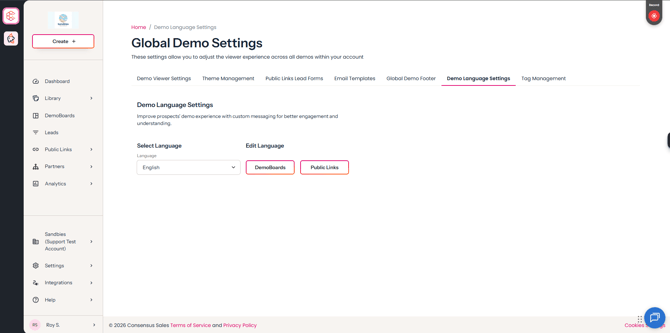
Global Demo Settings > Demo Language Settings default page
| Choose a Language and Link Type |
Each language has its own set of text, and DemoBoards and Public Links are customized separately, so you’ll pick both before you start editing.
- Open the Select Language dropdown and choose the language you’d like to customize. Consensus supports 19 languages: Chinese Simplified, Chinese Traditional, Czech, Danish, Dutch, English, Finnish, French, German, Indonesian, Italian, Japanese, Korean, Norwegian, Polish, Portuguese, Russian, Spanish, and Swedish.
- Under Edit Language, click DemoBoards (the personalized boards your team sends to buyers) or Public Links (the shareable links used on websites, emails, and campaigns).
You’ll know you’re in the right place when the page heading reads, for example, Edit English DemoBoards, with a grid of DemoPlayer screens underneath:
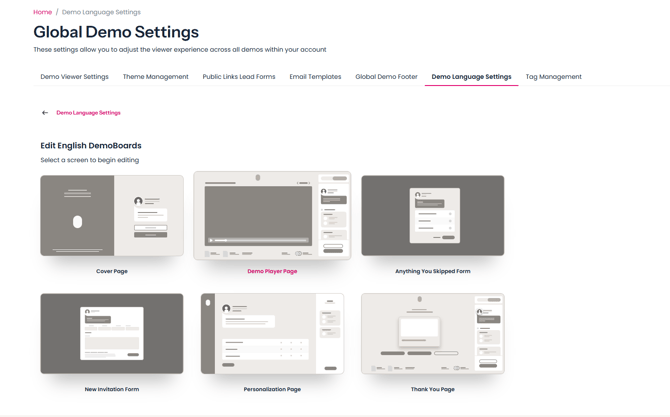
| Screens You Can Customize |
The screens follow the viewer’s journey through the DemoPlayer. Most appear for both link types, but each has one screen of its own.
- Cover Page (DemoBoards only) — the first screen viewers see, including the avatar message and the opt-in message.
- Lead Capture Form (Public Links only) — the form viewers fill in before watching.
- Demo Player Page — the main screen where viewers watch your demos.
- Anything You Skipped Form — the prompt about demos the viewer hasn’t watched yet.
- New Invitation Form (DemoBoards only) — the form viewers use to invite colleagues.
- Personalization Page — where viewers tell you what they’re interested in, with its own avatar message.
- Thank You Page — the closing screen at the end of the experience.
| Edit and Save Your Text |
With your language and link type selected, you can work through the experience screen by screen.
- Select the screen you’d like to edit. The editor opens with the text fields on the left and a live Preview on the right. On the Cover Page, for example, you can rewrite the avatar message’s Header and Body.
- Click into a field and type your new wording. As you edit, an orange highlight appears in the preview to show exactly where that text sits in the DemoPlayer, as shown below:
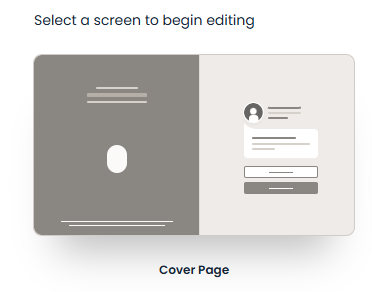
Editing the avatar message on the Cover Page
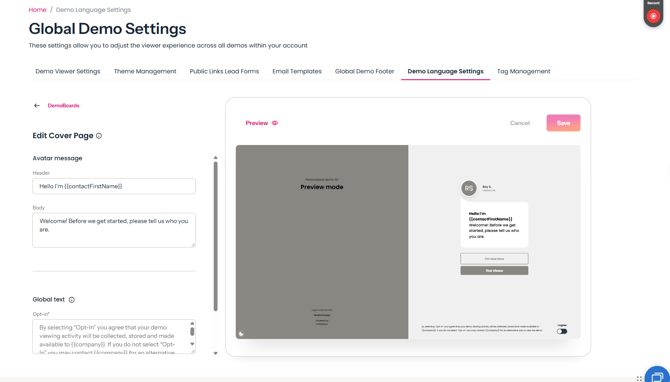
Cover page edit page
- When you’re happy with the wording, click Save in the top right. If you’d rather start over, Cancel discards your changes.
- Use the back link above the editor to return to the screen list and repeat for any other screens.
Once saved, your new text appears on every DemoBoard or Public Link of that type in that language, including ones you’ve already sent.
| Personalize Text With Variables |
For DemoBoards, you can add variables to the text so each viewer sees their own name, or the name of the person who sent the board. The default Cover Page header already does this, greeting viewers with the sender’s first name. When you click into a field that supports variables, you’ll see a hint underneath it. To add one, type the variable name inside double curly braces, as shown below:
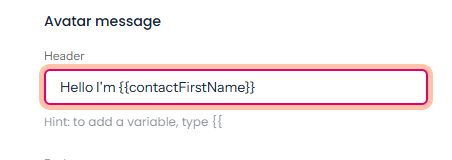
The variable hint under the Header field
- contactFirstName — the first name of the DemoBoard sender.
- contactLastName — the last name of the DemoBoard sender.
- viewerFirstName — the viewer’s first name.
- viewerLastName — the viewer’s last name.
- company — your company name, used in the opt-in message.
To use a variable, type its name between double curly braces, exactly as written, including the capitalization. Variables only work in certain text fields; if there’s no hint under a field when you select it, that field doesn’t support them.
| Customize the Opt-In Message |
The opt-in message is the consent text viewers see before their viewing activity is tracked. It lives on the DemoBoards Cover Page.
- On the Demo Language Settings tab, choose the language, then click DemoBoards.
- Select Cover Page.
- Scroll down to Global text. The Opt-in field holds the consent message, with the compliance notice shown just below it.
- Edit the message, keeping it within the 500-character limit, then click Save.
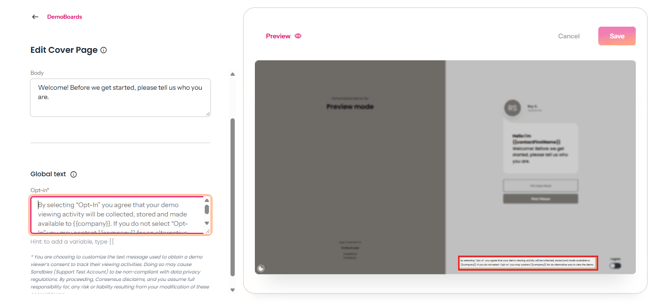
Cover Page > Global text > Opt-in
| Note We believe the opt-in message we have provided is sufficient for compliance purposes. Please note that if you customize the opt-in message, the following will apply: You are choosing to customize the text message used to obtain a demo viewer’s consent to track their viewing activities. Doing so may cause [your company] to be non-compliant with data privacy regulations. By proceeding, Consensus disclaims, and you assume full responsibility for, any risk or liability resulting from your modification of these consent terms. |
| Troubleshooting |
My DemoBoard displays in the wrong language (for example, Spanish). The DemoPlayer’s language comes from each demo’s own language setting, not from Demo Language Settings. The opening screens use the language of the first demo in the DemoBoard, and the DemoPlayer then switches to match each demo as the viewer opens it. So if your DemoBoard opens in Spanish, the first demo is set to Spanish; if it changes language partway through, one of the later demos is. To fix it, ask the demo’s creator or your admin to make a copy of that demo with the language you want, then replace the original demo in your DemoBoard with the new copy.
I can’t open or change Demo Language Settings. These settings affect your whole organization, so they’re limited to Admins. Ask an admin on your account to make the change.
My edits aren’t showing up. First, make sure you clicked Save before leaving the screen. Then check that you edited the right combination of language and link type: text changed under DemoBoards doesn’t change Public Links, and each language is customized separately.
| FAQ |
Will this translate my videos or captions? No. Demo Language Settings change the DemoPlayer’s interface text only. Your video content and captions stay as they were recorded.
Do changes apply to links I’ve already sent? Yes. Your saved edits apply to all existing and new DemoBoards or Public Links in that language.
Can one DemoBoard include demos in different languages? Yes. The DemoBoard opens in the language of its first demo, and the DemoPlayer switches to each demo’s language as the viewer opens it, using the text you’ve set for that language.
Can I use different text for DemoBoards and Public Links? Yes. Each link type has its own set of screens and text, so you can tailor them separately.
Can I use variables on Public Links? No. Variables are available for DemoBoards only, since Public Links aren’t tied to a specific sender or viewer.
| Keep Exploring |
Demo Viewer Settings · Opt-In and GDPR Compliance · Create, Edit, and Update Lead Capture Forms