
For different reasons, you may see an increased demand for Presales resources from the Sales team. It could be that Marketing is spending more and generating more leads. It could be that Sales is hiring and you don't have the correlating budget increase to hire in Presales. It could be that you're going down-market where volumes are higher but margins are tighter. Or qualification on demos is getting worse and you are spending more time on “wasted” demos.
Somehow, demand is growing. There are two questions you must answer:
- What’s causing the gap?
- What's the gap in your capacity to handle the incoming demand?
There are lots of ways to conduct a demand gap analysis. One of the simplest is to begin by calculating your AE:SE ratio. Research from our 2024 SE Workload and Compensation Report shows The average ratio of AEs to SEs has stayed steady at approximately 4:1 from last year, showing AE:SE uniformity across different assignments and roles. The consistency suggests that a limit of 3-4:1 is likely the maximum sustainable AE:SE ratio, influenced more by the nature of the product than the assignment type.
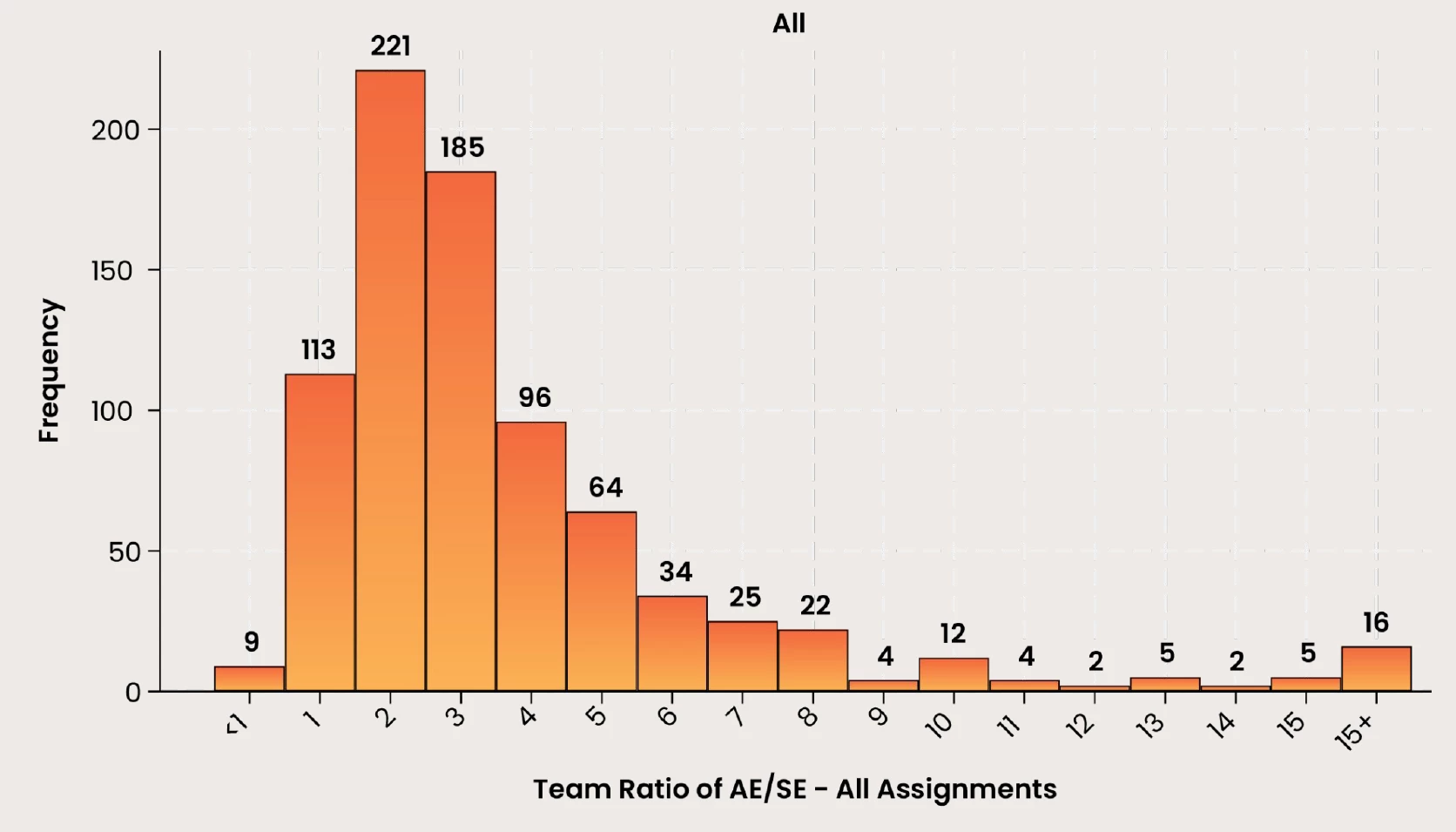 AE/SE Workload from 2024 Workload and Compensation Report
If you have 40 Sales Engineers with an AE:SE ratio of 4:1 and the Sales team grows to 230 Account Executives, you need 58 SEs to maintain that ratio, or 18 new SEs. Maintaining a ratio isn’t scaling – it’s
just linear hiring. But even if that’s how you wanted to solve this gap, Sales often grows through hiring without allocating a compensatory budget for Presales to hire on the same correlated path.
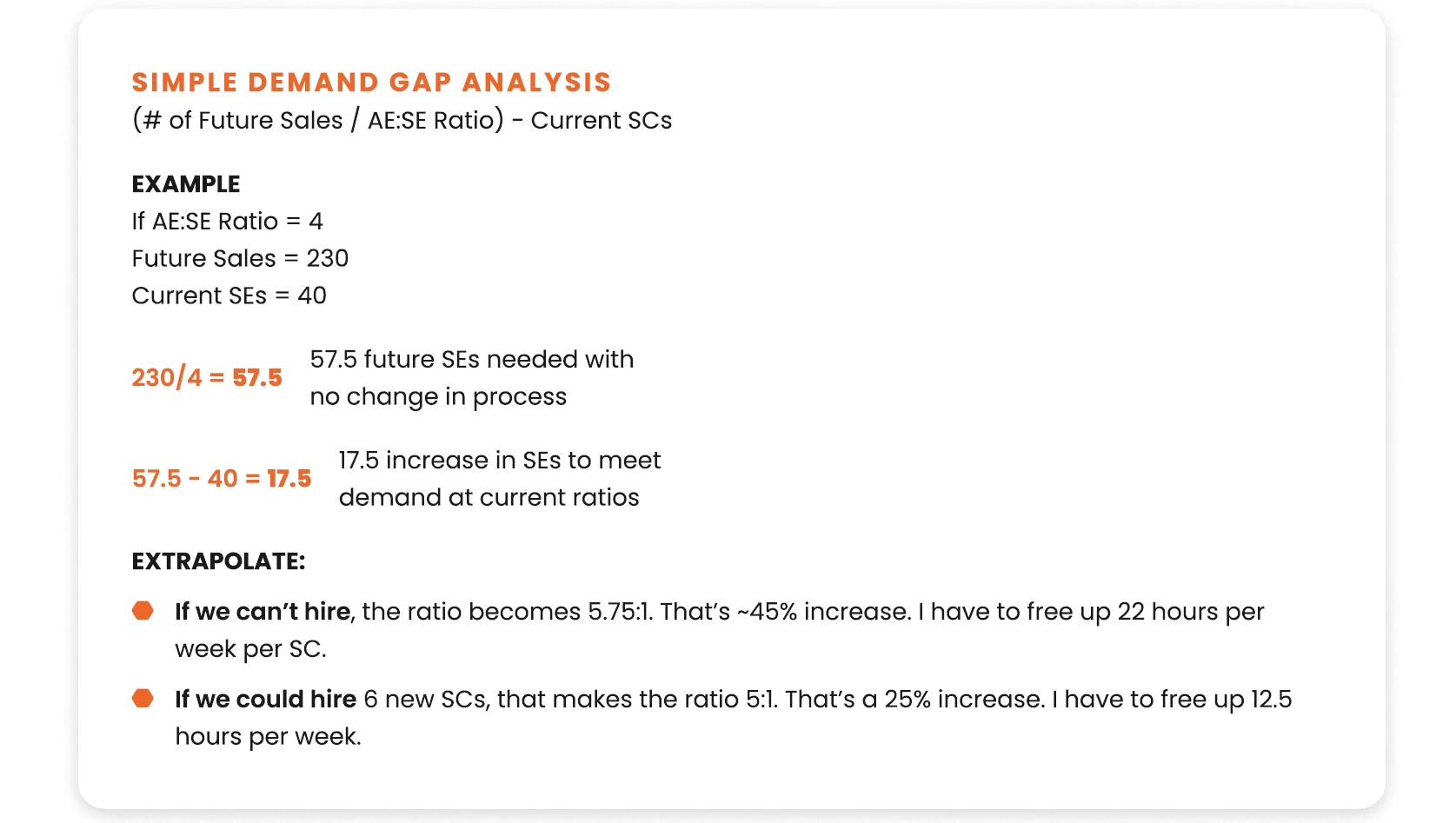 The Demand Gap Analysis calculation
If you can't keep up with any new hires, the new ratio shows a 45% delta, which means you have to
free up 22 hours per week per SE. If you allocated enough budget for 6 new SEs (assuming no attrition), instead of needing 18 new reps, it’s only 12, but that’s still a 25% increase in demand. Either you ask everybody to work an extra 12.5 per week, and burn them out, or you figure out how to free up 12.5 hours a week by scaling.
If 12.5 hours per week per SE is your Demand Gap (on a 50 hour workweek), multiply this by your total headcount to find the Demand Gap for the entire team. If you have 25 SEs, your demand gap is 312 hours per week or 1,250 hours per year.